
A person’s reaction to grief is an intense physical and emotional response. It is not wrong. It just is. Grief can overwhelm or numb. But there is also power and motivation in grief.
A German graphic artist and sculptor expressed raw emotions through her work. Her art focused on the struggles, sorrows, and joys of working-class people. It blossomed as a political statement, a statement of pacifism, and of the grief she felt. She saw it as her duty to voice the sufferings of humankind, even when it wasn’t easy, even when her own son lost his life in World War I, even when the Nazis threatened her, and when she faced more loss during World War II. This is the work and life of Käthe Kollwitz.
Family & Early Life
Karl Schmidt (1825-1898) was a lawyer and socialist in Königsberg, Prussia (modern-day Kaliningrad, Russia). He refused to serve the right-wing Prussian state, so quit being a lawyer and became a stonemason. He married Katharina Juliane Sophie Rupp, daughter of a Lutheran pastor who defied the Kaiser’s state-approved Lutheranism and created an independent congregation.
Karl and Katharina had two sons who did not survive their early childhood. They welcomed a son, Konrad, in 1863 and a daughter, Julie, in 1865.
On July 8, 1867, they welcomed their fifth child, Käthe (pronounced KEH-tuh or KAY-tuh). Lisbeth, their sixth child, came in 1870.
Early Education
Käthe’s parents valued manual work as much as education. They homeschooled their children and allowed them to explore literary treasures or wander the streets and docks of Königsberg. Käthe’s maternal grandfather gave the children lessons in religion and socialism. Her diary entries reveal that she found her grandfather’s sermons intimidating. But she absorbed his commitment to social duty as her own.
Her parents recognized their daughters’ gifts in drawing and sought educators for them.At twelve, Käthe started lessons in drawing and copying plaster casts.
Her first art teachers were the painter Gustav Naujok and the copperplate engraver Rudolf Mauer.
At sixteen, she began working on drawings of working people, sailors, and peasants she saw in her father’s office.
Engaged
In 1884, her older brother, Konrad, a journalist, economist, and enthusiastic member of the German Social Democratic Workers Party, introduced Käthe to his friend, a socialist medical student, Karl Kollwitz.
Soon, seventeen-year-old Käthe and twenty-one-year-old Karl became engaged.
But Käthe’s father did not believe a woman could be both a serious artist and a wife and mother, so he sent Käthe away to the only formal art school open to women: Berlin’s Women’s Art School. He thought the separation in time and distance would cool their affections for one another.
Advanced Education
In 1885, Käthe studied art under Karl Stauffer-Bern, a Swiss painter, etcher, and sculptor, at the School for Women Artists in Berlin. Under Stuffer-Bern, she first saw the etchings of artist Max Klinger, whose work played an important role in her artwork later on.
She found inspiration in the works of Rubens in the art museum in the Kunstareal area in Munich, Germany, the Alte Pinakothek. It was and remains one of the oldest galleries in the world and houses a significant collection of Old Masters.
From 1888 to 1889, she went to the Munich Women’s Art School where she studied painting under Ludwig Herterich, a German painter and art teacher best known for portraits and historic paintings. Käthe experienced a breakthrough around this time. She realized she was not a painter. Her strength was in drawing. She also took an interest in the movement of naturalistic plein-air painting, spearheaded by Max Liebermann and Fritz von Uhde. Drawn to naturalistic literature and women’s rights, Käthe started exploring gender issues.
In 1898, she won a teaching position at the Berlin Academy for Women Artists. She offered classes in etching a drawing from live models until 1903.
Käthe focused on graphic art after 1890 and produced etchings, lithographs, woodcuts, and drawings.
Marriage & Motherhood
In 1891 she married Karl Kollwitz and went to live with him among his patients in a working-class district in North Berlin (now East Berlin). She established her studio in a small room across the hall from his in-home medical office. Gaining firsthand glimpses of the misery of the urban poor, Käthe often sketched the women and children who waited to see her husband.
After the birth of their first son, Hans, in 1892, Karl hired a live-in housekeeper, Lina, so Käthe could continue her work as an artist.
In 1896, she gave birth to a second son, Peter.
Career
After her second son’s birth, Käthe saw a performance of “The Weavers,” a dramatization of the oppression of the Silesian weavers in Langenbielau and their failed revolt in 1844 by Gerhart Hauptmann. The performance so inspired Käthe that she stopped working on a series of etchings she had intended to illustrate Émile Zola’s Germinal. She produced a cycle of six works on the weavers’ theme. She called them “Ein Weberaufstand” (“A Revolt of Weavers”). It consisted of three lithographs (Poverty, Death, and Conspiracy) and three etchings with aquatint and sandpaper (March of the Weavers, Riot, and The End).

In 1898, she exhibited the cycle publicly to wide acclaim. She entered “The Weavers” in the Great Berlin Exhibit of 1898. German Realists artist, Adolph Menzel nominated “The Weavers” for the exhibit’s Gold Medal. Kaiser Wilhelm II refused to approve giving Käthe the medal. “I beg you gentlemen, a medal for a woman, that would really be going too far…” One year later, the King of Saxony agreed to award the medal in Dresden. Käthe became recognized as one of the foremost artists in her country.
In 1901 Käthe visited the draughtsman, lithographer, poster artist, etcher, and painter Théophile-Alexandre Steinlen in Paris. Steinlen’s socio-critical caricature-like representations of the social environment had established his artistic reputation. It seems she drew strength from his example.
It was in Paris she met art dealer and collector, Otto Ackerman, who introduced her to the Paris art galleries and that became a connection that boosted her career.
The Peasant War
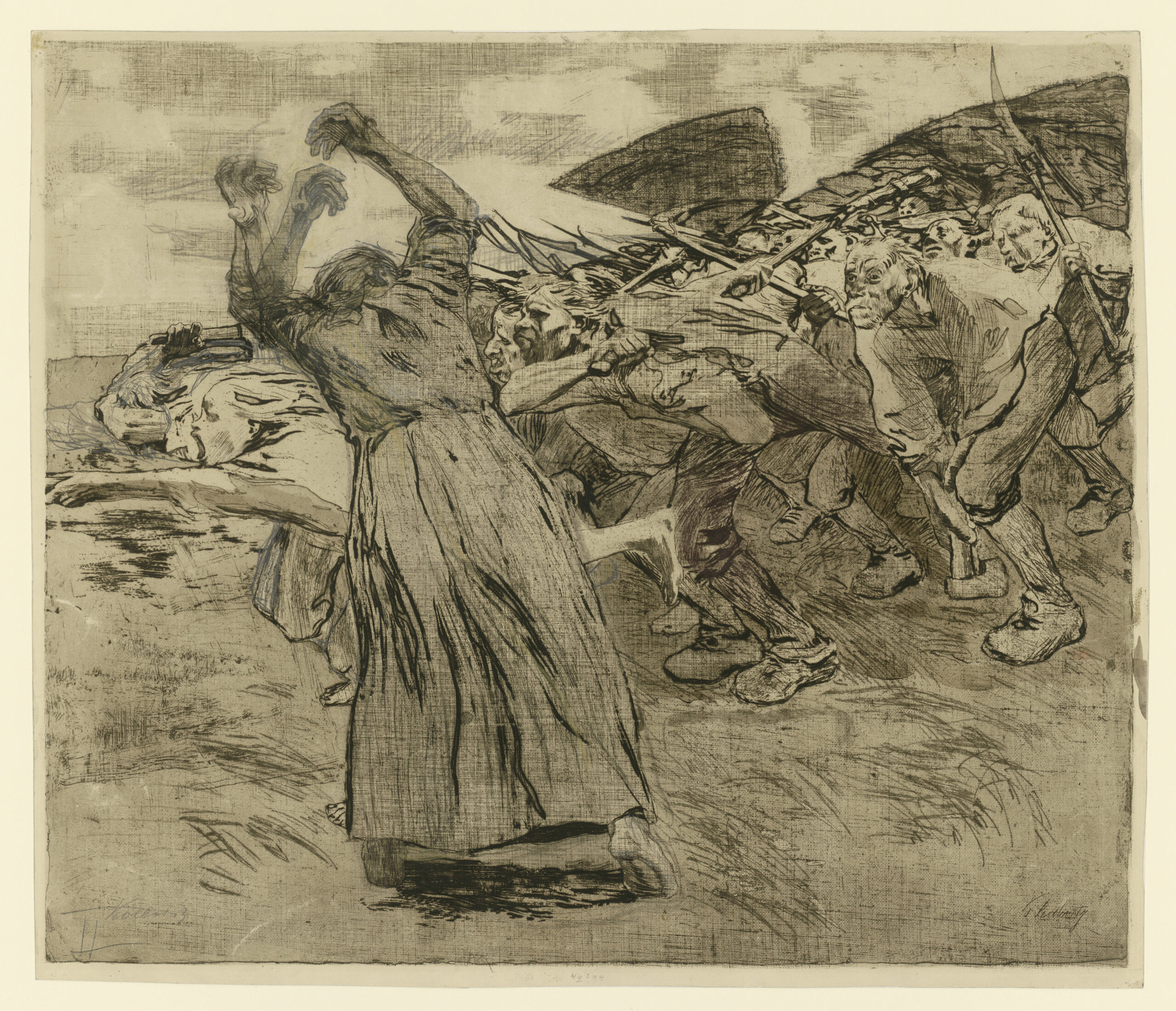
In 1902, Käthe began her second major cycle, the Peasant War, inspired by the German Peasants’ War of 1524-1525. She made many preliminary drawings and visited Paris twice while working on this series. She took sculpting classes in 1904 at the Académe Julian, did colored art work between 1901 and 1904, and presented thirteen of her works at the exhibition of the Paris Salon des Indépendants in 1905.
She finished the series, “Bauernkrieg” (Peasants’ War) in 1908. This cycle had seven etchings: Plowing, Raped, Sharpening the Scythe, Arming in the Vault, Charge, The Prisoners, and After the Battle. These drawings are emotionally raw. That solidified her critical acclaim and reputation. After the Battle features a mother searching for her son’s body in the night. In just six short years, Käthe would know exactly how that mother felt.
Milestones
Between Peter’s birth and his death, Käthe built a body of work and a reputation that crossed borders and irritated the powerful.
In 1909, she executed her first bronze cast work. The Portraitrelief Julius Rupp was a commemorative stone in Königsberg celebrating the 100th anniversary of Rupp’s birth.
She created more sculptural drafts between 1910 and 1912, including a small-scale sculpture called Woman with Child on her Lap.
Her poster, the Greater Berlin Administration Union, denounced the extreme housing shortage in the city. An association of landlords complained, which led to that poster being banned. That a piece of paper hung on a wall threatened them says a lot about the power of Käthe’s work. And it was only the first time her work would be banned.
In 1912, she was elected a board member of the Berliner Secession until it split. Also that year, more than her reputation crossed borders and an ocean. The Print Room of the New York Public Library staged what was probably the first solo exhibition of Käthe’s works in the US. Her artwork obviously spoke to a much broader audience than the German landlords suspected.
In 1913, she and others founded the Frauenkunstverband (Association of Women Artists).
She joined the Freie Secession, an association of artists in Berlin, in 1914 and life was good. It wouldn’t stay that way.
World War I
In 1914, Germans’ whose political diversity divided them united against their enemies. Even committed socialists like Käthe and her husband got swept up in the pull of German nationalism and flew the German flag from their home.
Both Käthe’s sons were eager to serve in the military. Eighteen, Peter needed his parents’ permission to enlist. Käthe willingly gave her permission. Six weeks after Germany invaded Belgium, Peter was killed in action on the Western Front. How can a mother live for the rest of her life with the knowledge that she gave her son permission to enlist and go to his death ?
Käthe’s sorrow and depression shifted her beliefs and the themes of her work. She became a pacifist, a view she expressed in action and her work. From then on her already emotional work expressed not only her objections to war; it expressed her need to protect the youth of Germany with extra urgency and emotion.
Continuing Despite Loss
By the end of 1914, Käthe began sketches and drawings of a monument to Peter and his fallen comrades.
In the meantime, she exhibited her first finished sculpture, Liebesgruppe (Group of lovers), at the 1916 spring exhibition of the Freie Secession.
In 1917, on her 50th birthday, the Paul Cassirer galleries held a retrospective exhibition of one hundred fifty drawings by Käthe. It was her first big show. The show appeared in Königsberg, Dresden, Hamburg, and Mannheim.
It wasn’t long before war broke out again. The German Revolution of 1918 led her to write an open letter countering a call for a final war effort. It was published in two different magazines and rapidly disseminated.
The Armistice of November 11, 1918, ended fighting on the Western Front.
A Time of Change
In 1919, the Prussian Academy of Arts appointed her to the position of professorship, which included a regular income and a large studio. She was the first woman given a full professorship there. At her request, the role did not include teaching.
She became a member of the main committee of the Bund Neues Vaterland, the most important pacifist association in the First World War. That same year, she destroyed the drawings for the monument to Peter and his comrades.
To add to her grief, the artist whose work heavily influenced her from her teens onward, died. On behalf of the Freie Secession, Käthe gave a eulogy for Max Klinger (1857-1920).
She designed a poster, Flyers against Profiteering, that campaigned against post-war deprivation. View some of her posters on Käthe Kollwitz museum.
June 28, 1921, she wrote, “I have been through a revolution and I am convinced that I am no revolutionist. My childhood dreams of dying on the barricades will hardly be fulfilled, because I should hardly mount a barricade now that I know what they were like in reality. And so I know now what an illusion I lived in for so many years. I thought I was a revolutionary and was only an evolutionary…. How good it is when reality tests you to the guts and pins you relentlessly to the very position you always thought, so long as you clung to your illusion, was unspeakably wrong.”—Helen Englehardt, “The Jewish Connections of Käthe Kollwitz,” Jewish Currents.
New Life & New Art
Käthe’s oldest son, Hans, and his wife had a son in 1921. They named him Peter, after Käthe’s youngest son and Hans’ brother.
She completed her woodcut print series, War (The Sacrifice, The Volunteers, The Parents, The Widow I, The Widow II, The Mothers, and The People), between 1922 and 1923.
She became a grandmother again in 1923 when her son and his wife had twin girls, Jordis and Jutta.
Perhaps her she kept her own young grandchildren in mind while she finished her three most famous posters in 1924: Germany’s Children Starving, Bread, and Never Again War (“Nie Wieder Krieg”).
Her poster, Never Again War, for the Central German Convention of Young Socialist Workers became an icon of the peace movement after World War II.
She also created a lithograph to include in the portfolio Starvation.
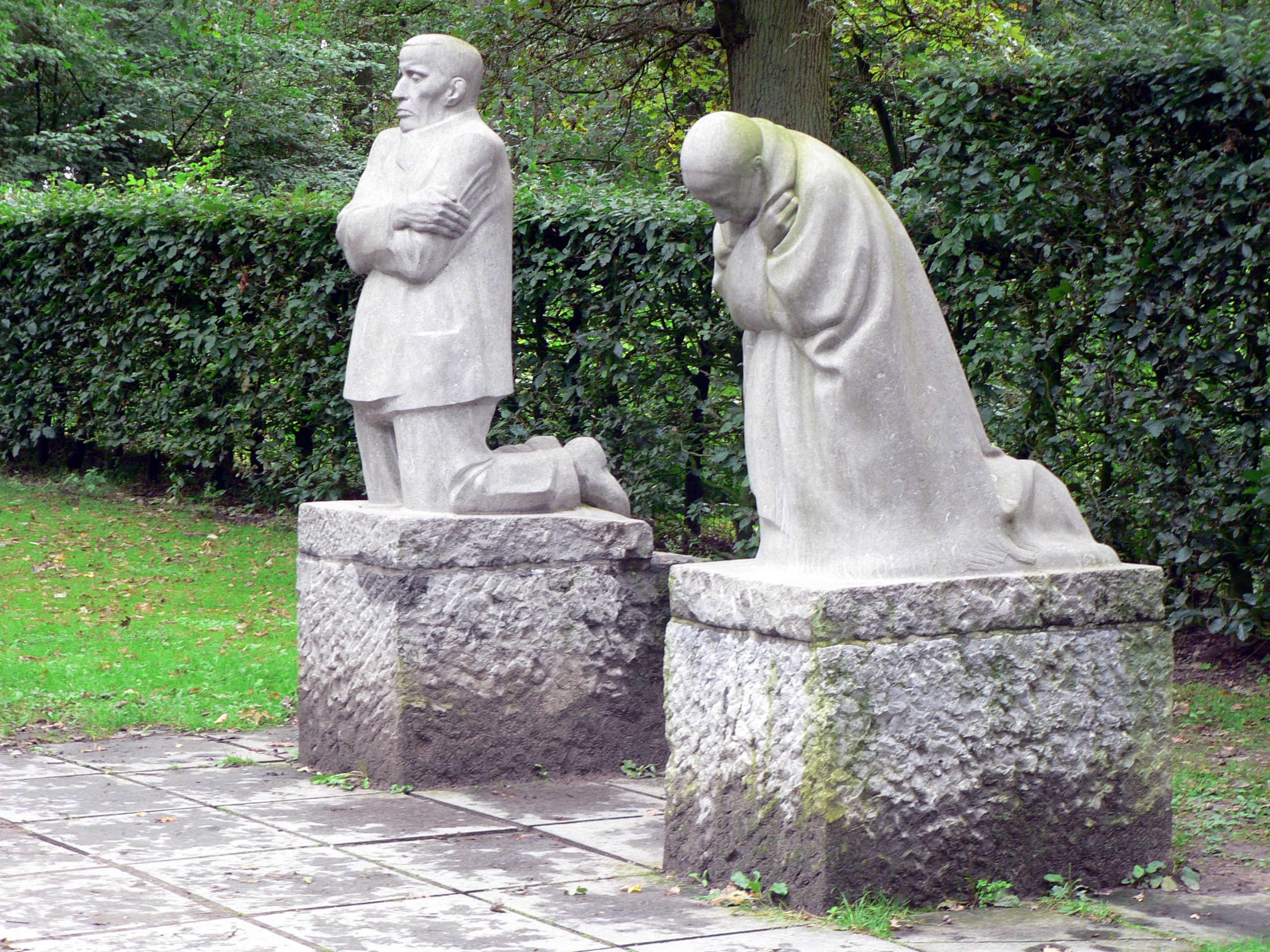
In 1924 she designed a new memorial for Peter which she completed in 1932. It depicted her husband her herself, as grieving parents. She titled the statue, The Grieving Parents. It was placed in the Belgian cemetery of Roggevelde. Later, they moved Peter’s grave and the statues to Vladslo German war cemetery.
Käthe’s mother died in 1925.
Later Years
At the height of her fame, sixty-year-old Käthe received many honors, received more than 500 letters and telegrams with birthday wishes, and many birthday celebratory exhibitions of her work in New York, several cities in Germany and in Geneva.
In 1928, the Prussian Academy named her director of the Master Class for Graphic Arts. With this position, she received two large workrooms at the academy’s venue in Hardenbergstrasse.
Käthe became the first woman to be awarded the Pour le Mérite for Science and Art on May 29, 1929.
Her youngest grandson, Arne Andreas, was born in 1930.
In July 1932, Käthe and her husband traveled to the war cemetery in Roggevelde, Belgium, to supervise the installation of the memorial she designed for her son.
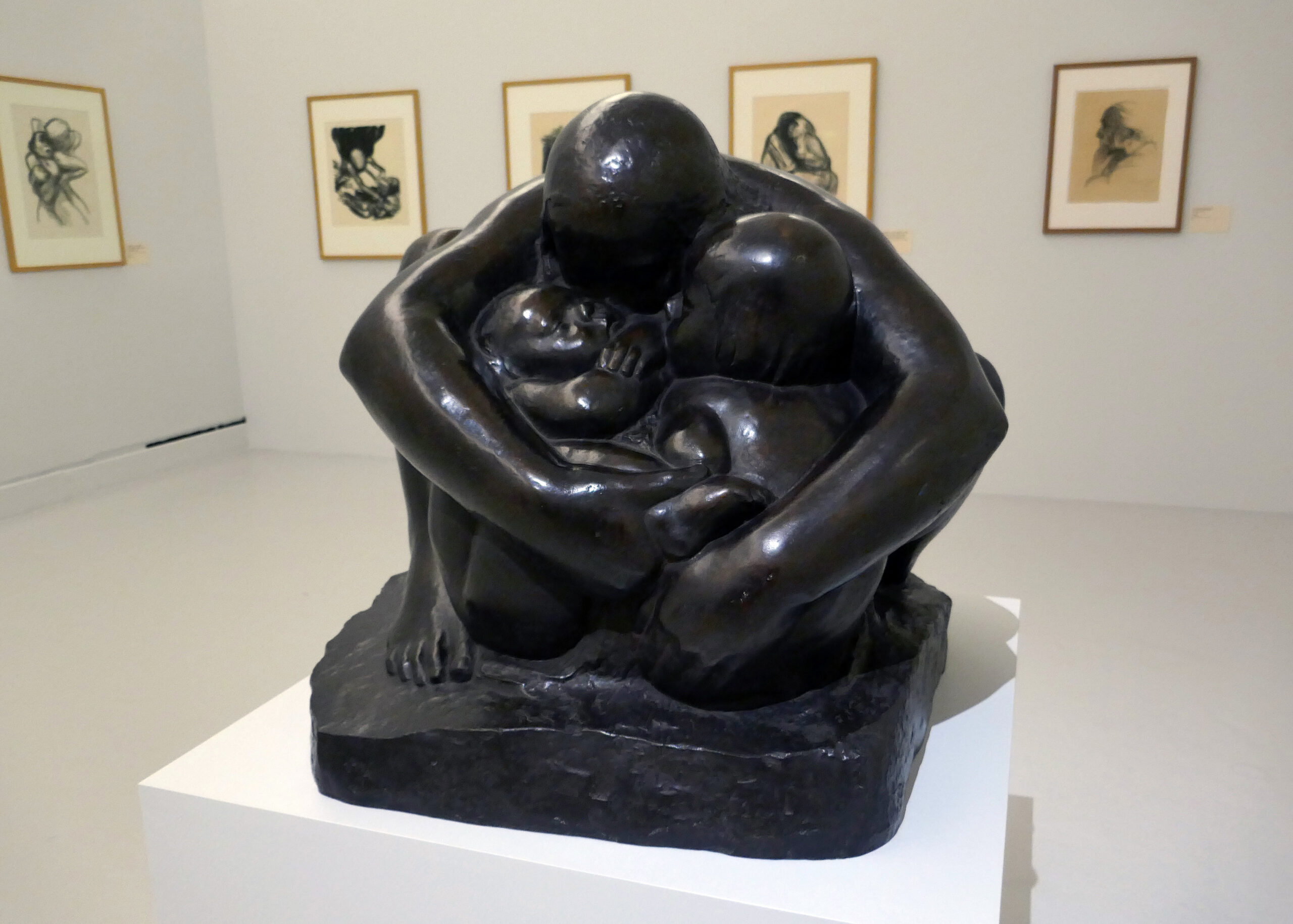
After they returned, she had a new clay model made for her group of mothers statue she’d started in 1914.
Life in Nazi Germany
Käthe put up posters, organized and signed a public manifesto calling for socialists and communists to unite and defeat the Nazis in the March 1933 election. For this, she was forced to resign from the Prussian Academy of Arts. She was denied the use of studio space; her works removed from museums, and she was banned from exhibiting any of her art. Ironically, one her of her “mother and child” pieces was used by the Nazis in their propaganda.
In March, she and her husband went to Czechoslovakia but returned after a few weeks.
In July, her husband lost his license to practice. His protests were successful, and he and other physicians who were members of the Social Democratic Association of Physicians regained their licenses.
Her son, Hans, lost his post as a school physician. His house was searched by the police, and books about his mother were confiscated. He regained his post after a short period.
Quiet Protests
Käthe continued her quiet protest by producing and selling art she could no long show in public.
In 1934 she began working on the last of her print cycles, Death.
On September 14, 1935, the Reichskulturkammer, rendered a judgement against Käthe. But she was a publicly known artist and an influential individual. Her work was familiar and beloved by the German people. So the judgment rebuked her for clinging to communist ideas and for lacking any potential for sincere conversion to the National Socialist cause. But it also declared her art worth preserving for the German people, despite her error—if they saved it.
She finished her rearranged sculpture, formerly called group of mothers, and titled it Mother with Two Children, in 1936.
The Gestapo visited Käthe and her husband in July 1936. She refused to give them the names of communists friends and didn’t reveal that her sister was the widow of a German Jew. Threatened with arrest and deportation to a Nazi concentration camp, Käthe and her husband agreed to commit suicide if that seemed inevitable. But she once again her status as an international figure probably saved her. The Gestapo never returned.
On July 8, 1937, she turned seventy. More than 150 telegrams arrived from leading figures in the art world. Many of those included offers of safety in the United States. She declined for fear of reprisals against her family.
Her Sorrow Deepens
In 1939, Karl’s health forced him to give up his medical practice.
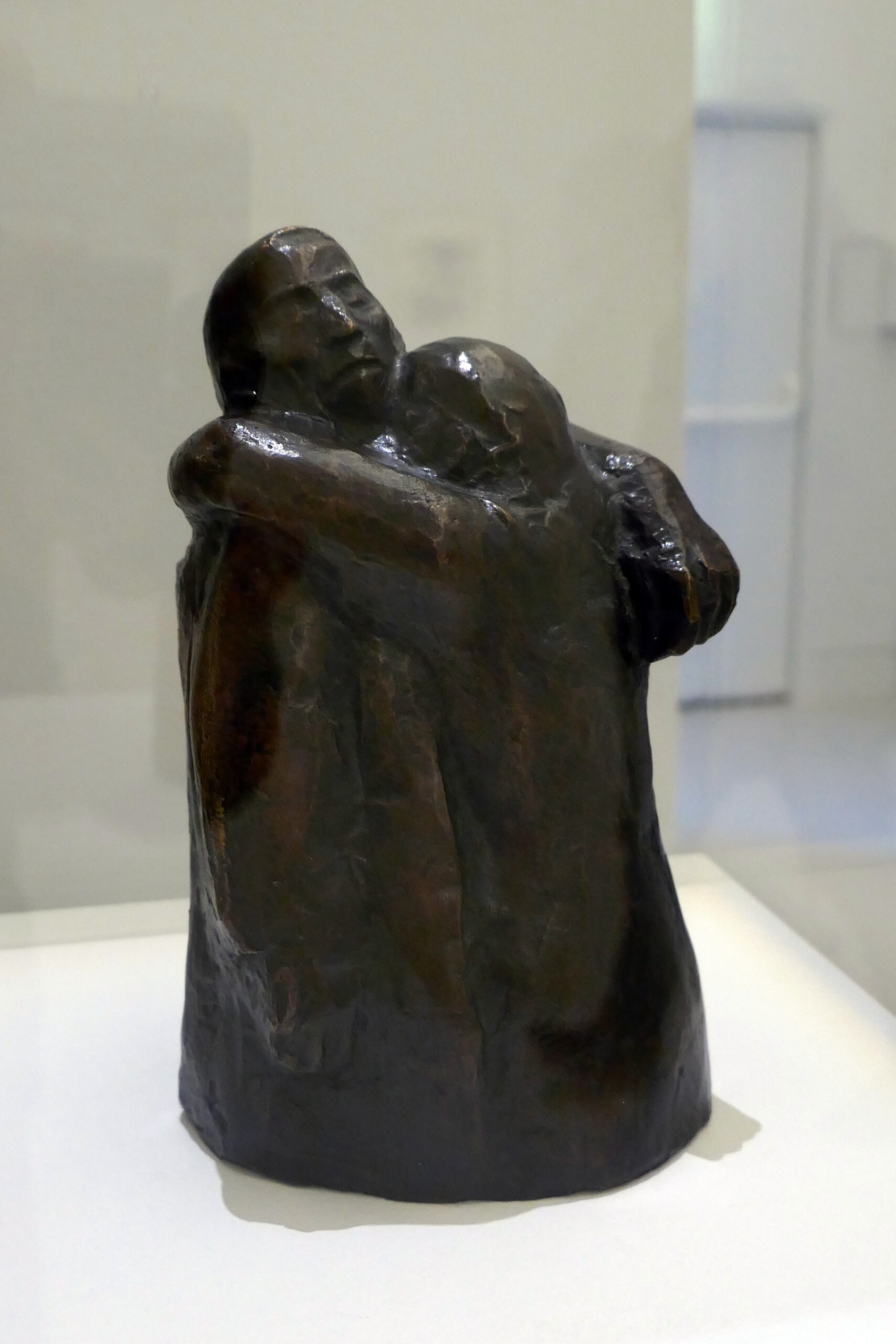
He died in 1940. Käthe expressed her loss by completing the small-scale sculpture, Abshied (Farewell) in 1941.
She created her last lithograph, Saatfrüchte sollen nicht vermahlen werden (Seeds for sowing should not be ground).
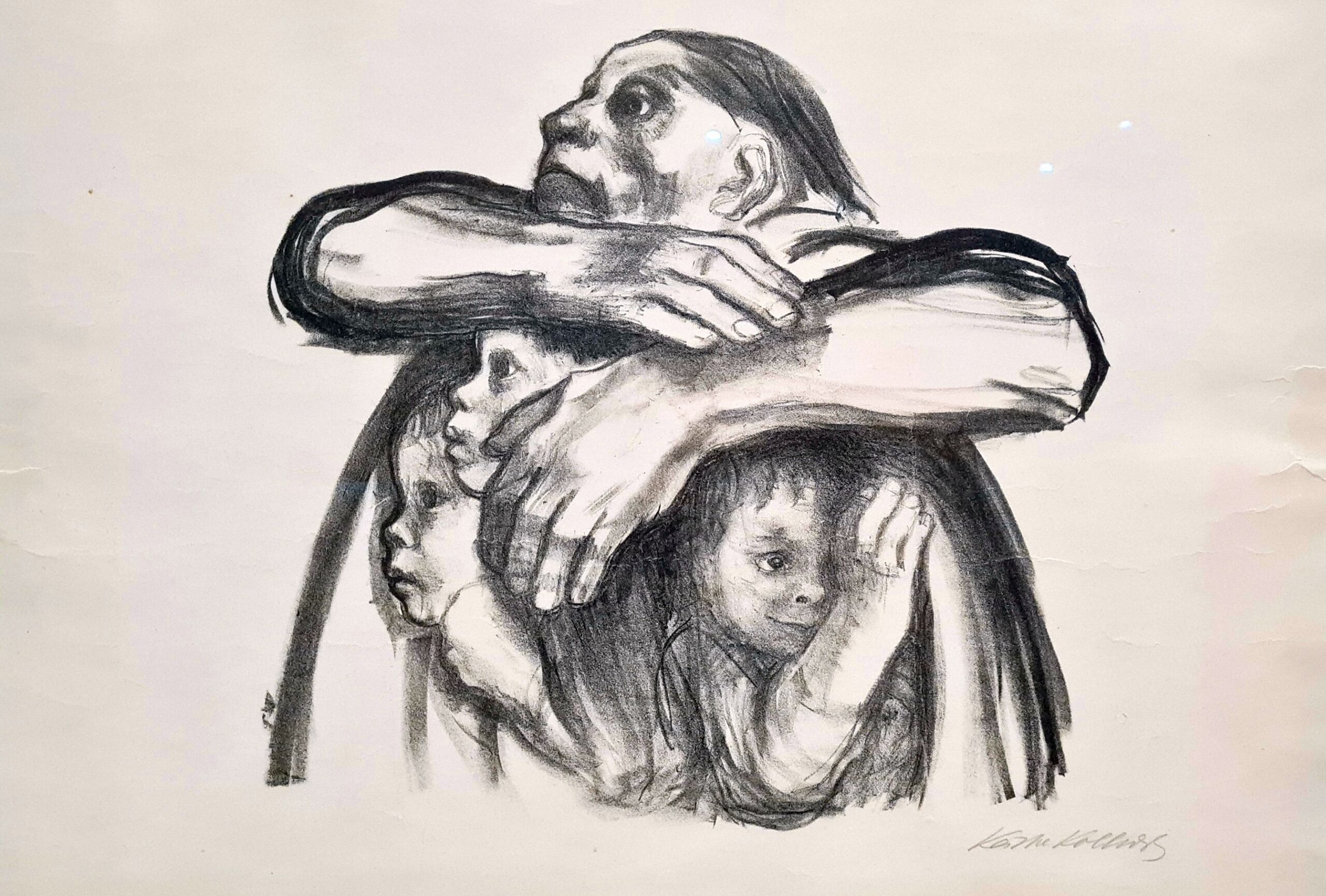
The image depicted mothers trying to protect their young sons. The title is a metaphor: sons should not be milled or ground by war. By autumn that year she gave up her studio in Klosterstrasse.
As if Käthe hadn’t suffered enough, her grandson, Peter, was drafted. And like his namesake, he was killed in action on September 22, 1942 on the eastern front near Rzhev.
Air Raids
In 1943, she increasing air raids on Berlin made her leave her home for more than 50 years. She moved in with the sculptor Margret Böning in Nordhausen, Thuringia.
In in late November, an air raid destroyed her home in Berlin along with many of her drawings, prints, and documents. The house of her son, Hans, was severely damaged by another air raid in early December.
Death
At seventy-seven, Käthe Kollwitz died on April 22, 1945, in Moritzburg, just 16 days before the end of the war. A few close friends attended her April 24th funeral at the local cemetery.
After the war ended, her body was exhumed and taken to Dresden for cremation. On November 27th, relatives and official guests gathered for another funeral ceremony. Following her wishes, Käthe was laid to rest in the family grave at the central cemetery in Berlin-Friedrichsfelde Cemetery.
Legacy
Käthe was one of the last practitioners of German Expressionism and is counted among the top artists of social protest in the twentieth century. She made 275 prints in etching, woodcut, and lithography in her lifetime. Most of those documented the suffering of those who lacked power: the poor, the soldiers, the children.
Though much of Käthe’s work was destroyed in the 1943 Berlin air raid, her work gets pulled out, not just for anniversaries but for anti-war movements, humanitarian crises, and those times when people need an image that expresses what they are feeling.
In 1946, a dance school performed Dances for Käthe Kollwitz in Dresden.
In 1960, they established the Käthe Kollwitz Prize.
A film, Käthe Kollwitz, aired in 1986.
The Diary and Letters of Kaethe Kollwitz was published in 1988.
In 1993, officials placed an enlarged version of Mother with her Dead Son at the center of Neue Wache in Berlin, a monument to the “Victims of War and Tyranny.” That is an extraordinary statement about what her work means to an entire nation.
Käthe Kollwitz is a subject in William T. Colman’s book, Europe Central, a National Book Award winner for fiction. Her story is in the chapter entitled “Woman with Dead Child.”
And Her Legacy Continues
An exhibition of her work curated by art historian Corinna Kirsch was shown at the Weisman Art Museum at the University of Minnesota in 2012.
In 2014, the Dallas Museum of Art exhibited Käthe Kollwitz: A Social Activist in the Era of World War I. Actress Christina Grobe played Käthe in the series 14 – Diaries of the Great War that same year.
Google Doodle marked her 150th birthday with a doodle in 2017. And the Ikon Gallery in Birmingham, England held an exhibit, Portrait of the Artist: Käthe Kollwitz that subsequently appeared in Salisbury, Swansea, Hull and London.
The Museum of Modern Art in New York held a retrospective exhibition of her work in 2024.
Today there are at least four museums dedicated to her work in Cologne, Koekelare, and Berlin, Germany.
She grew up in a family that valued education. She was barred from the best art schools because of her gender. And she spent years teaching women art because they had no other options. Today more than 40 German schools are named after her.
Käthe Kollwitz didn’t hide behind her acclaim. She created art that protested. She didn’t allow her grief to make her withdraw. Instead she made art that wept and raged with her grief. What she understood was that grief is not a weakness and that sorrow has the power to express precise political language. That is what makes every generation pull her work out of history and into contemporary light. That is perhaps her most extraordinary achievement: art so rooted in her own suffering that it became everyone’s.
References
1. Britannica
4. National Museum of Women in the Arts
Image Credits
1. Featured image: Self-Portrait at the Table” Käthe Kollwitz, Public domain, via Wikimedia Commons
.jpg)
2. A Revolt of Weavers, Käthe Kollwitz, Public domain, via Wikimedia Commons

3. Peasants War, Käthe Kollwitz (Q142472), Public domain, via Wikimedia Commons
_K%C3%A4the_Kollwitz-Bauernkrieg_1920256.jpg)
4. Grieving Parents, Käthe Kollwitz, Public domain, via Wikimedia Commons

5. Mother with Two Children, Artist: Käthe Kollwitz (1867-1945) / photo Ji-Elle, CC BY-SA 3.0, via Wikimedia Commons

6.The Farewell, Artist : Käthe Kollwitz (1867-1945) / photo Ji-Elle, CC BY-SA 3.0, via Wikimedia Commons

7. Seeds should not be ground up, lithograph by Käthe Kollwitz/photo byDerbrauni, CC BY 4.0 , via Wikimedia Commons

